How to Tell If a Tree Near Your House Needs to Be Removed
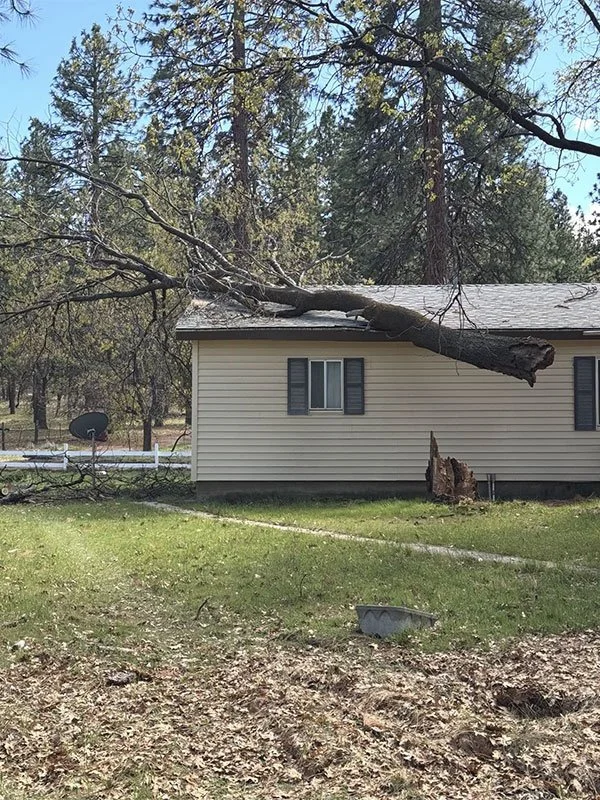
Most trees do not need to come down. That is the first thing worth saying, because in Redding and across Shasta County, a lot of homeowners assume that any tree showing problems is a tree that has to go. Sometimes that is true. Often it is not. The job is figuring out which one you have.
Here are the signs that actually matter, based on what we see most often on properties around Redding, and the rural areas across Shasta and Tehama County.
Is a Leaning Tree Always Dangerous?
A leaning tree is not always dangerous, but a tree that has recently started leaning, or whose lean is getting worse over time, usually is. Trees that have always grown at an angle have typically compensated by developing stronger root systems on the opposite side. The real problem is a tree that is actively moving.
Watch for soil heaving on the side opposite the lean. If you can see exposed roots pulling up out of the ground, or cracks forming in the dirt around the base, the tree is shifting. That is not a tree you can wait on.
Do Dead Branches Mean the Whole Tree Needs to Come Down?
Dead branches do not automatically mean the whole tree has to be removed, but large dead limbs in the upper canopy are one of the most common hazards we deal with. They snap in wind, and fall during summer heat with no warning (something arborists call "summer branch drop"). And they tend to come down on roofs, vehicles, and people.
Signs a branch is dead:
Bare gray wood with no leaves during the growing season
Bark that is peeling or falling off
Fungus or mushrooms growing on the limb
Brittle wood that snaps cleanly instead of bending
A few small dead twigs near the trunk are not usually a crisis. Large dead limbs over your house or driveway are a different conversation. Depending on the rest of the tree's health, those branches can sometimes be removed without taking the whole tree.
Are Cracks in a Tree Trunk a Sign It Needs to Be Removed?
Cracks in a tree trunk are often a sign of structural failure, especially deep vertical cracks running down the stem or any crack at the junction where major branches meet the trunk. Horizontal cracks are less common but tend to be more serious. Some cracks are old and stable, and others are active and spreading. The difference matters, and it is hard to tell from the ground without experience. If a crack appears after a storm, or you notice it has grown since the last time you looked, get a professional tree company out before the next windy day.
What Do Mushrooms Growing at the Base of a Tree Mean?
Mushrooms or shelf fungus at the base of a tree usually mean the wood is rotting internally, and that is a serious problem. The tree can look perfectly healthy in the canopy while the structure inside is breaking down.
Common culprits in our area include Armillaria (honey fungus) and various heart rot fungi. A tree with significant internal decay can fail without much warning, and when it goes, it tends to go at the base. Everything above it comes down at once.
Can Damaged Roots Cause a Tree to Fall?
Yes, damaged roots are one of the most common reasons a tree fails in a storm, even when the canopy looks fine. Trees rely on their root system for stability, not just water, and the effects of root damage can take years to show.
Common ways tree roots get compromised:
Excavation or grading near the tree (driveway work, foundations, utility trenching)
Soil piled around the trunk, which suffocates roots and causes rot
String trimmers girdling the bark at the base
Vehicles repeatedly driving over the root zone
Disease or fungal infection in the root crown
If any of these have happened on your property within the last few years, the tree is worth a closer look.
Does Storm Damage Always Require Tree Removal?
Storm damage does not always require removal, but a tree that took serious damage and was only patched up at the surface often needs a real assessment before the next storm season. Cracked limbs, split crotches, and partially uprooted trees can hold together for months and then fail when the wind picks up again.
After winter storms in Northern California, we get a lot of calls about trees that "lost a few branches but seem okay." Some of them are. Some have hidden structural damage that becomes a real problem the next time bad weather hits.
Should You Remove a Healthy Tree That Is Too Close to the House?
Sometimes, yes. A tree that is structurally healthy can still be in the wrong place. A small ornamental planted ten feet from the foundation thirty years ago is now a forty-foot tree pressing against the eaves. It is not sick, it has just outgrown its location.
This is one of the most common reasons we recommend removal, and it is rarely urgent. But it is worth thinking through before the roots reach your foundation, before the canopy starts dropping limbs on the roof, and before you have a tree growing into the electrical service drop.
What Tree Problems Are Usually Not a Reason to Remove?
Plenty of things look alarming but are not actually signs that a tree needs to come down. The most common ones we get asked about:
Leaves turning yellow in summer (usually drought stress, not death)
Sap leaking from a wound (often the tree healing normally)
Woodpecker holes (usually means insects, and not always the kind that kill the tree)
A few dead twigs in the lower canopy (normal on most species)
Surface roots above the ground (common in older trees, rarely a structural issue)
Honest assessment matters here. We have walked properties where the homeowner expected to lose three trees and only needed real work on one. We have also walked properties where someone wanted a single trim and the tree above their bedroom had structural failure that was not visible from the ground.
When Should You Call a Tree Service for an Assessment?
Call a professional any time you notice signs of failure on a tree close enough to your house, garage, fence, driveway, or power lines that a fall would cause damage. The cost of an honest evaluation is always less than the cost of waiting too long.
At All Aspect Tree Service, we do free on-site estimates throughout Redding, Anderson, Shasta Lake, Cottonwood, Palo Cedro, Red Bluff, Shingletown, Burney, and the wider Shasta and Tehama County area. Trevor, the owner, is usually the one walking your property. If the tree needs to come down, we will tell you why, what the work involves, and what it costs. If it does not, we will tell you that too.
Frequently Asked Questions
How close is too close for a tree to be to my house?
It depends on the species and how big the tree will get at maturity. A general rule is that the canopy should not be in contact with the roof, and large mature trees like oak, pine, or redwood should be at least fifteen to twenty feet from the foundation. Smaller ornamental trees can be closer. The real risk is less about distance and more about what would happen if the tree failed in your direction.
Will my homeowners insurance pay to remove a hazardous tree?
Most homeowners insurance policies do not cover preventive removal of a tree that has not yet fallen, even if it is clearly hazardous. Insurance usually only kicks in after a tree falls and causes damage to a covered structure. That said, some insurers now require removal of a hazard tree as a condition of keeping your policy. If you have received a notice from your insurance company about tree clearance or hazard compliance, we can help you meet those requirements.
Do I need a permit to remove a tree on my property in Redding?
Permit requirements vary by location and species. Most standard residential tree removal on private property in Redding does not require a permit, but protected species, heritage trees, and certain zones may have additional rules. Shasta County and Tehama County have their own requirements for rural and unincorporated areas. We can help you find out what applies to your property before any work begins.
How long does it take to remove a large tree?
A straightforward removal of a mid-sized tree typically takes a few hours. A large tree close to a house, with limited access, or requiring crane work can take a full day or longer. Cleanup, stump grinding, and brush hauling are usually included or quoted separately depending on the job.
Can I remove a tree near my house myself?
Removing a tree near a house is not a DIY job. Even experienced people get seriously hurt every year doing this work, and the risk goes up dramatically when there is a structure to protect. Beyond the safety issue, most homeowners insurance will not cover damage caused by unlicensed tree work on your property. Hire someone who is licensed, insured, and has done it before.
What is the best time of year to remove a tree in Northern California?
You can remove a tree any time of year. That said, late fall and winter are often easier for scheduling, give crews better access to dormant trees, and avoid disrupting bird nesting season. If a tree is actively failing, time of year does not matter. Get it down.
Need a free estimate, or have a tree emergency? Call All Aspect Tree Service. We serve Redding and the surrounding Shasta and Tehama County communities with 24/7 emergency response and honest, owner-led tree care.