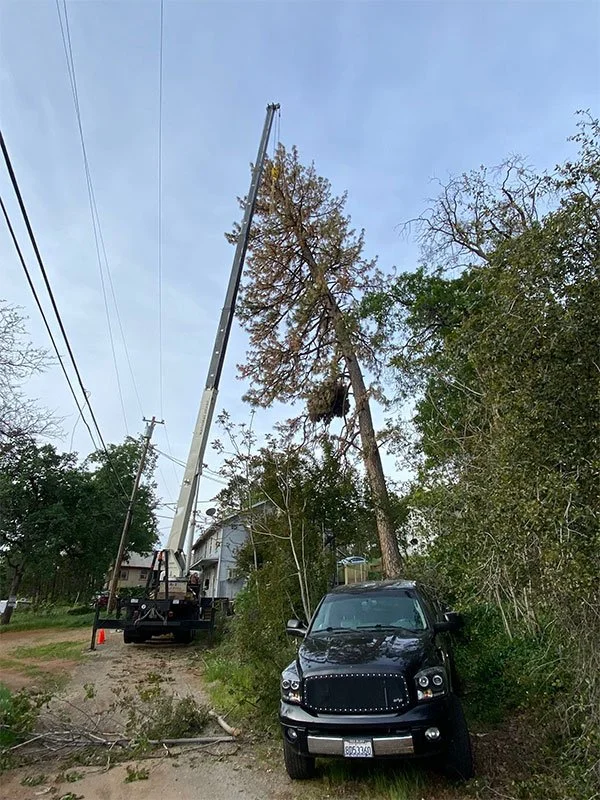
If you have a large tree in your backyard that needs to come down, you have probably looked at it and wondered how anyone is supposed to get it out of there without destroying everything around it. Maybe it is wedged between the house and the fence. Maybe it hangs over the garage, the neighbor's property, or a set of power lines. Maybe the only access to your backyard is a narrow side gate, and you cannot figure out how a crew would even get equipment back there. This is one of the most common concerns we hear from homeowners in Redding, Anderson, Palo Cedro, and the surrounding Shasta County area, and it is a reasonable one. Large tree removal in a confined backyard is genuinely complex work. But it is also work that professional crews do every week, and the process is a lot more methodical and controlled than most people expect. Here is how it actually works, from the initial assessment through final cleanup.
Why Can't You Just Cut a Large Tree Down in One Piece?
Felling a large tree in one piece requires enough open space for the entire trunk and canopy to land safely, and backyards almost never have that kind of room. When a tree is surrounded by structures, fences, landscaping, utility lines, or neighboring properties, dropping it whole would cause more damage than the removal is meant to prevent. The risk of misjudging the fall direction, even by a few degrees, is too high when the margin for error is measured in feet rather than yards. Instead, professional crews take the tree apart in sections, working from the top down in a controlled sequence that keeps every piece of wood going exactly where they want it. This approach is called sectional dismantling (sometimes referred to as "piecing out" a tree), and it is the standard method for any large removal in a tight residential setting. The process is slower than a straight fell, but it gives the crew complete control over where the weight goes at every stage.
How Do Tree Climbers Take Apart a Large Tree from the Top Down?
The process usually starts with a climber. A trained climber ascends the tree using ropes, a climbing saddle, and spiked boots, and begins removing the canopy in manageable sections starting at the top. Each limb is evaluated for weight, lean, and where it will swing once it is cut, and the climber makes precise cuts that allow the wood to either free-fall into a clear drop zone on the ground or be lowered on a rope by the ground crew. For smaller limbs and upper canopy, free-falling sections into a designated area is common as long as the ground crew has cleared the zone and confirmed it is safe. For larger, heavier limbs that are directly over a roof, fence, or other structure, the climber ropes the piece before cutting it so the ground crew can control the swing and lower it slowly. This is called rigging, and it is one of the most important skills in residential tree removal. A properly rigged limb does not fall. It is guided to the ground on the crew's terms. Once the canopy is stripped, the climber works down the trunk in rounds, cutting sections (called "cookies" or "rounds") that are short enough to handle safely. Each section is either dropped into the open or lowered on a line depending on what is below it. The trunk gets shorter and shorter until the final stump cut is made at ground level.
When Does a Backyard Tree Removal Require a Crane?
A crane becomes necessary when the tree is too large, too heavy, too compromised, or too tightly surrounded by structures for a climber to safely dismantle it using ropes alone. Crane-assisted tree removal is also the right call when the tree is dead or severely decayed, because dead wood is unpredictable and a climber cannot safely trust their weight to a trunk or limb that might snap without warning. During a crane removal, the crane operator positions the boom above the tree, and the climber attaches sections of the trunk or major limbs to the crane's rigging before making the cut. Once the piece is free, the crane lifts it up and over any obstacles (the house, the fence, the power lines) and sets it down in a staging area where the ground crew breaks it down. This allows the crew to remove massive pieces of wood that would be impossible to lower safely by hand, and it dramatically reduces the time the climber needs to spend in a compromised tree. Crane removal does require access for the crane itself, which means there needs to be a spot on the street, driveway, or adjacent lot where the machine can set up and reach the tree. Part of the planning process is figuring out crane placement, boom reach, and whether any obstacles need to be temporarily addressed before the work begins.
What Does the Ground Crew Do During a Tree Removal?
The ground crew is doing just as much work as the climber, and their coordination is what keeps the job safe and efficient. While the climber is cutting and rigging sections overhead, the ground crew is managing ropes, directing the fall of each piece, clearing wood from the drop zone, feeding brush into a chipper, and stacking logs for removal. On a typical large backyard removal, the ground operation includes:
A rigging line operator who controls the speed and direction of lowered limbs using friction devices or mechanical advantage systems
Crew members clearing the drop zone between each cut so nothing stacks up and creates a hazard
A chipper operator feeding branches and brush as they come down, which keeps the work area clean and reduces the number of trips needed to haul debris
A spotter watching for hazards the climber might not be able to see from above, including power lines, loose rigging, and shifting wood.
The whole operation depends on constant communication between the climber and the ground crew. Hand signals, voice calls, and sometimes radios keep everyone in sync so that no piece of wood moves until the entire team is ready for it. This kind of coordination is part of what OSHA's tree care safety guidelines are designed to reinforce, and it is a major reason why professional tree removal is so much safer than attempting the work without a trained crew.
How Do Tree Crews Get Equipment into a Backyard with Limited Access?
Limited access is one of the defining challenges of backyard tree removal, and it is something experienced crews plan for before they ever show up on the job. During the initial estimate, the crew assesses every possible access point to the tree, including side gates, neighboring properties (with permission), removable fence panels, and even overhead clearance for crane work from the street. In many cases, the tree work itself is done entirely by hand and rope. The climber goes over or through the fence on foot, and every piece of wood comes out the same way, either carried by hand, rolled on a dolly, or dragged with a rope to a staging area where equipment can reach it. Brush and smaller limbs get chipped on-site if there is room for the chipper, or they are hauled out in manageable loads. For properties where a crane can reach the tree from the street or driveway, access through the yard becomes less of an issue because the crane lifts the heavy sections out overhead. This is one of the reasons crane removal is sometimes more practical than rope-only work in tight backyards. It is not always about the size of the tree. Sometimes it is about the only realistic path for getting the wood out.
What Happens to the Stump After a Tree Is Removed?
Once the tree is down and the wood and debris are cleared, the stump is typically ground out using a stump grinder. A stump grinder is a machine with a rotating cutting wheel that chews the stump and the top layer of major roots down to several inches below ground level. The result is a hole filled with wood chips and loose soil that can be raked level, backfilled, and eventually planted over or covered with sod. Stump grinding is not always included in a tree removal quote, so it is worth asking about upfront. Some homeowners choose to leave the stump temporarily if they are not ready to decide what to do with the space, but grinding it out at the same time as the removal is usually the most cost-effective option since the equipment and crew are already on-site. If the stump is in a tight spot, such as between a fence and a foundation or next to a retaining wall, smaller grinders can usually reach it. Access is rarely a dealbreaker for stump grinding, even on properties where the tree removal itself required crane work.
How Long Does It Take to Remove a Large Tree from a Backyard?
A large backyard removal typically takes anywhere from half a day to a full day depending on the size of the tree, how much rigging is involved, whether a crane is needed, and how difficult the access and cleanup are. Very large trees, multi-tree jobs, or properties with severe access limitations can occasionally stretch into a second day. The removal itself is only part of the timeline. Cleanup, chipping, log removal, stump grinding, and final site cleanup add time, and a good crew accounts for all of it in the estimate. When we quote a job, we include the full scope of work so there are no surprises once the crew is on your property.
Frequently Asked Questions
Will removing a large tree damage my yard?
Some yard impact is unavoidable on a big removal, especially in tight spaces. Heavy limbs landing in the drop zone can dent soft ground, and equipment like stump grinders and chippers leave tracks on wet soil. A good crew minimizes this by using ground protection where possible and cleaning up thoroughly, but it is realistic to expect some wear on the lawn or garden beds closest to the tree. Most of it recovers within a few weeks with normal watering.
Do I need to be home during the tree removal?
You do not have to be, but many homeowners prefer to be around for at least the start of the job. Being home gives you a chance to confirm the scope of work with the crew, point out anything you want protected, and ask questions before the cutting begins. If you cannot be there, clear communication beforehand about access, gate codes, and expectations will keep the job on track.
Can you remove a tree that is right against my house?
Yes, and this is more common than most people realize. Trees growing directly against a home, pressing into the eaves, or with limbs resting on the roof require extra care, but they can be safely removed through sectional dismantling and rigging. Crane-assisted removal is sometimes the best option when the tree is large and the margin for error is especially small. This is exactly the kind of job where hiring a licensed, insured crew matters most. The International Society of Arboriculture recommends that any tree work involving proximity to structures or power lines be performed by trained professionals using industry-standard risk assessment methods.
What do you do with the wood after the tree is removed?
All wood, brush, and debris are hauled off the property as part of the job unless you want to keep some of it. Some homeowners like to keep firewood rounds or larger log sections for splitting. Let the crew know before the work starts what you want to keep and where you want it stacked, and they will set it aside as they go.
How do I get a quote for a backyard tree removal?
Call us to schedule a free on-site estimate. We need to see the tree, the access, and the surroundings in person before we can give you an accurate number. Estimates over the phone or from photos alone are not reliable for large removals because there are too many variables that only show up on-site.
Need a big tree removed from your backyard? Call All Aspect Tree Service for a free estimate. We handle large, complex, and hard-to-reach removals throughout Redding, Anderson, Shasta Lake, Cottonwood, Palo Cedro, Red Bluff, Shingletown, Burney, and the wider Shasta and Tehama County area, with honest pricing, professional equipment, and owner-led service.